By Swapna Tarafdar
In India, approximately 1.56 million to 1.6 million new cancer cases are reported annually. Around 870,000 to 900,000 cancer related deaths are reported every year in India. Still, less than 1 per cent of India’s population (men and women both) opt for voluntary screening for cancer.
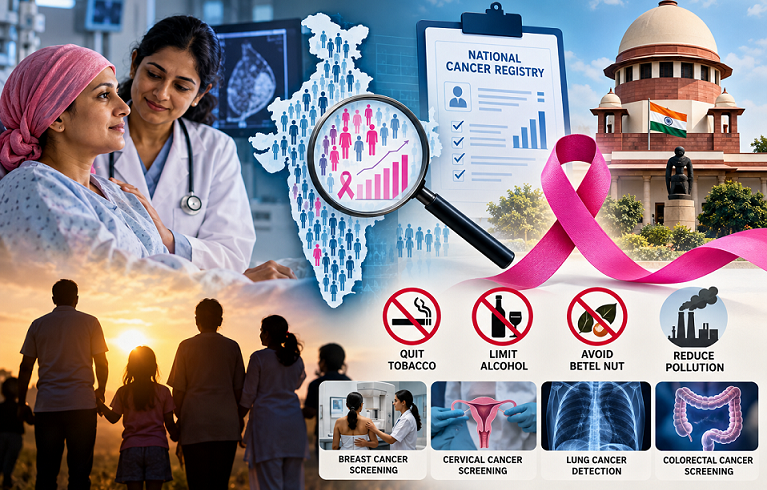
India’s Supreme Court in an order issued in August made it compulsory reporting of cancer cases to a national population-based cancer registry. After Supreme Court’s order, it has become mandatory for States and Union Territories which have not yet notified cancer as a notifiable disease to register each and every case.
“Making cancer a reportable disease lets authorities track cases accurately and launch targeted programs to lower cancer rates. Less than one per cent of the national population undergoes voluntary cancer screening. It is a notified disease in the United States and that is why today there has been a steady decline in the overall annual incidence of colorectal cancer.,” Dr Anurag Srivastava, retired professor & head, Department of Surgical Disciplines AIIMS New Delhi who had approached the Supreme Court to address severe systemic gaps in India’s cancer control framework.
Dr Srivastava said that the data related to deaths and cases only capture about 10 to 16 per cent of the total population. “Thus, 84 to 90 per cent of India’s population is not represented in the National Cancer registry.”
Reporting of cases
Citing the need for a nationwide mandate, Dr Srivastava said, “There will be exact reporting of the cancer burden across the nation. It will help in reporting of different types of cancers (organ wise – oral, lung, breast, cervix etc.), age of onset of different cancer types, state wise distribution of cancer types, possible risk factors related to environment, pollution, usage of tobacco, beetle nut, alcohol and infections.”
He said that once Indian government has the exact data of cancer case in different states and union territories, “it would be possible to set up the required infrastructure, manpower and equipment deployment, and medicines allocation needed for comprehensive treatment and prevention of cancer”. “There is a plan of National Health Mission (NHM) at the Ministry of Health & Family Welfare, Government of India, to set up Day Care Cancer Centre (DCCC) in each district general hospitals in all 802 districts. This will require appropriate infrastructures, equipment in the form of x-ray, CT scan, mammography machine, ultrasound, biopsy and pathology facility, radiotherapy, anti-cancer chemotherapy drugs, and adequate number of surgical oncologists to perform surgery for cancer patients. Exact planning and implementation of this DCCC programme mandates exact record of magnitude of different types of cancer in each district in different states.” Dr Srivastava said that there is an urgent need to control and curb the main causative factors of cancer, viz. tobacco, alcohol and betel nut consumption. Pollution also causes cancer.
Status of Cancer in India
He said that breast cancer is the leading and most common cancer in India. “On an average, 90,000 to 98,000 women die from breast cancer in India every year. At least, 70 to 80 per cent of all cancer cases are detected at an advanced stage (Stage 3 or 4). So, once this data is in place government will have an idea where cancer clusters are forming and can initiate control activities like build infrastructure and deploy facilities including early screening and medications in place. Patients in rural areas must receive the same high-quality treatment protocols as those in tier-1 cities.”
“Cancer reported anywhere in the world brings about a feeling of shock, helplessness and impending economic ramifications of huge proportions. This is because people know that chances of survival are low, while diagnostic and treatment costs are very high, with average out-of-pocket expenditure being 2.5 times higher than the average cost of hospitalisation.”
Till date, only 17 Indian states, namely Haryana, Karnataka, Kerala, Tamil Nadu, Punjab, West Bengal, Assam, Mizoram, Tripura, Sikkim, Gujarat, Manipur, Rajasthan, Arunachal Pradesh, Andhra Pradesh and Himachal Pradesh, have made notification of cancer mandatory.
The ruling, mandates that every government hospital, private oncology centre, diagnostic pathology lab, and community clinic must legally report every confirmed cancer diagnosis to state health directorates and the National Cancer Registry Programme (NCRP) under the Indian Council of Medical Research (ICMR).
Global Cancer Observatory has predicted a staggering 57.5 per cent rise in cancer cases in India by 2040, amounting to an increase of 2.08 million cases. Denmark started its cancer registry way back in 1942, covering its entire national population. England and Wales, the USA, Scotland, the Nordic countries, Canada, Australia, New Zealand, Israel, Cuba, Puerto Rico and Gambia all have nationwide cancer registration. “When a country first makes cancer a notifiable disease, the number of reported cases initially goes up, not down. This happens because the legal mandate forces private and public hospitals to report every case, catching thousands of patients who previously fell through the cracks of incomplete voluntary tracking systems. However, once the data becomes 100 per cent complete, it acts as the foundation for targeted public health actions that aggressively lower cancer rates over time.”
{The Writer had worked in PTI, Muscat Daily, The Statesman, Metro Now and Today of India Today Group)
