Swapna Tarafdar
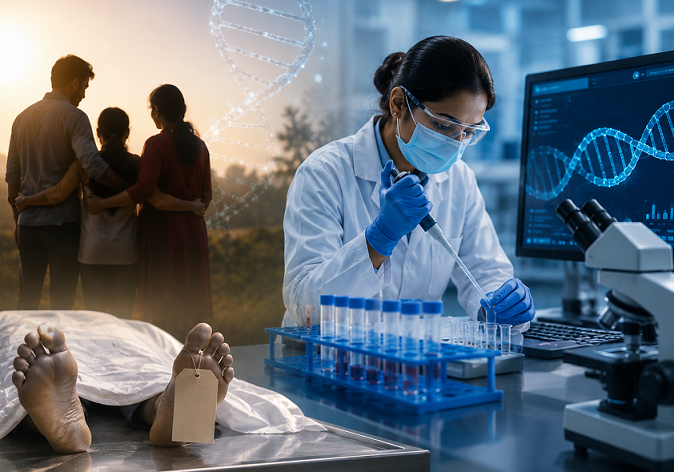
In a novel initiative, AIIMS Delhi and ICMR have started a project to help identify unclaimed bodies through DNA testing and bring a closure to their families. The project is being executed at 14 centres of UMID (Unidentified Bodies Missing Persons Identification Portal and DNA database) .
Developed by the department of Forensic Medicine and Toxicology of AIIMS, the portal analyses photographs, anthropometry, tattoos or marks, clothing and DNA profiles to identify unknown bodies. Two other collaborating centers, along with the Biology Division of the Central Forensic Science Laboratory (CFSL), CBI, Delhi, and the NFSU Delhi campus, also providing assistance for the project.
“Unclaimed bodies have their identity buried. But somewhere, someone must be looking for them. This portal has the DNA database of Unidentified Bodies and Missing Persons. People go missing after running away from homes due to mental health crisis, distress, or personal conflicts. For youth, it involves leaving home or care facilities, while for adults, it often stems from severe stress, depression, or medical issues like dementia. So data not alone of bodies but also missing persons who are alive is being incorporated, “Dr Chittaranjan Behera, professor and principal investigator of the UMID project, department of Forensic Medicine and Toxicology, AIIMS, New Delhi said.
India is now the most populated country in the world with a population of 1.4 billion. As of now, approximately 50,000 dead bodies remain unidentified every year. Apart from these, more than 3,00,000 persons are also reported missing in India annually. “In Delhi alone, 2000 unclaimed bodies surface every year. Of them 90 percent are decomposed,” he added.
This database encompasses data from AIIMS, New Delhi, and thirteen other participating centers across the country, including AIIMS Bhubaneswar, Bhopal, Rishikesh, Raibareli, Gorakhpur, Kalyani, Deoghar, Nagpur Patna, Bhatinda, BibiNagar, Mangalgiri, Guwahati, Bilaspur, JIPMER Puducherry, VMMC and Safdarjung Hospital, NEIGRIHMS Shillong and MAMC New Delhi.
He said that the police take measures to identify them by publishing their available phenotypic characteristics such as height, facial features, complexion, hair colour, tattoos, scars, and descriptions of clothes on several visual and print media platforms and recently through the zonal integrated police network (ZIPNet). Unfortunately, the current established protocol for the identification of the unknown corpses has not achieved much success and the efforts of the police officials remain futile as 80-90% of the bodies are still unidentified.
Dr Behera said that thousands of DNA profiles of unidentified bodies have been generated and securely stored in a DNA database, along with their phenotypic details (questioned database), available on the website to assist individuals searching for their loved ones. Biological samples are collected at our all the 14 centers with the consent of the investigating officer, however, they are sent to AIIMS, New Delhi (coordinating centers) for STR profiling (genotyping) and uploaded to the database.
